

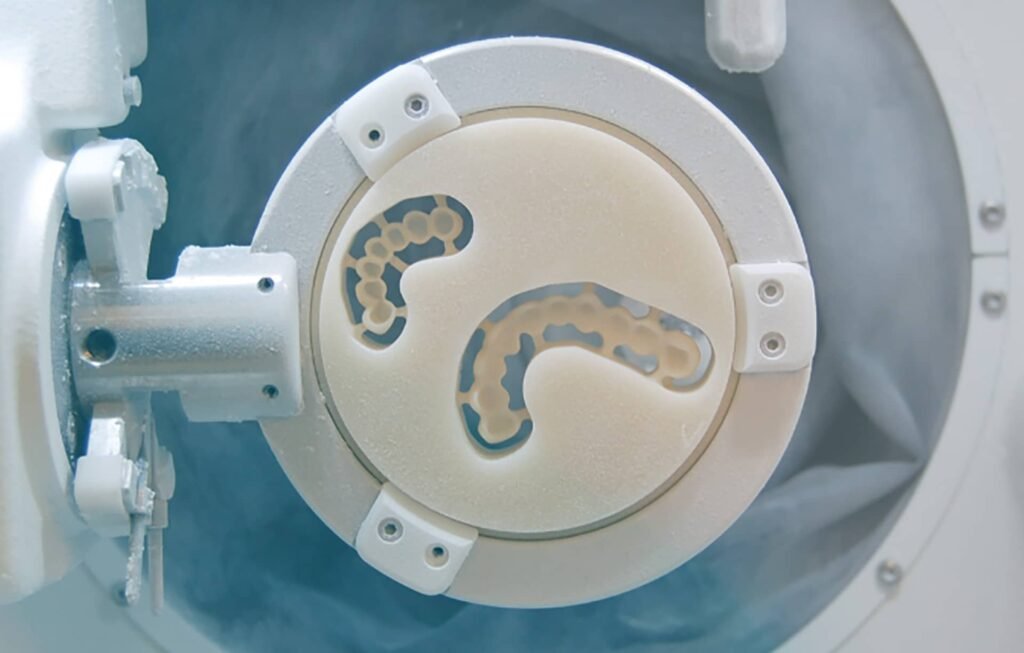
Precision-Crafted Restorations at Edgehill Ceramics
At Edgehill Ceramics, we use Computer-Aided Design and Computer-Aided Manufacturing (CAD/CAM)technology to produce highly accurate, durable, and aesthetic dental restorations.
CAD/CAM technology has transformed modern dental laboratories by replacing traditional manual techniques with a fully digital workflow. This allows us to design and manufacture crowns, bridges, and other restorations with exceptional precision and consistency.
In today’s rapidly advancing world, digital technology continues to shape the future of dentistry, enabling laboratories to deliver restorations that are stronger, more accurate, and more natural-looking than ever before.
One of the greatest advantages of CAD/CAM technology is the accuracy it provides at every stage of the restoration process.
Digital impressions
Dentists use intraoral scanners to capture a precise 3D model of the patient’s teeth and preparation.
The digital impression is instantly transferred to the laboratory, eliminating delays associated with traditional impressions.
Superior accuracy
Unlike traditional impression materials that can distort, shrink, or expand, digital scans maintain a highly accurate representation of the tooth structure.
This reduces microscopic gaps between the restoration and the natural tooth.
Clinical result
Improved marginal fit
Reduced risk of decay beneath the crown
Less post-operative sensitivity
Longer-lasting restorations
CAD/CAM technology allows us to work with advanced restorative materials that provide exceptional strength and reliability.
Milling from monolithic blocks
Restorations are milled from solid blocks of materials such as zirconia or lithium disilicate (E-Max).
This creates a restoration that is chemically uniform and structurally strong.
Consistent quality
Monolithic restorations eliminate weak points that can occur with layered materials.
These restorations are particularly suitable for posterior teeth and bridges, where chewing forces are highest.
Digital design software allows our technicians to precisely tailor each restoration to the patient.
Virtual design
Using advanced CAD software, technicians design the crown or bridge digitally.
Contacts, contours, and occlusion can be carefully adjusted before manufacturing.
Virtual articulation
The software can simulate jaw movement and the patient’s bite.
This helps ensure restorations fit comfortably and require minimal chairside adjustment.
Shade matching
CAD/CAM materials are available in a range of shades and translucencies.
This allows restorations to closely mimic the appearance of natural enamel.
The Computer-Aided Manufacturing (CAM) stage uses automated milling machines to fabricate the restoration with exceptional consistency.
Automated production
The milling machine produces the restoration exactly as designed in the CAD software.
This significantly reduces human error associated with traditional waxing and casting techniques.
Faster turnaround
Digital workflows reduce production times.
Restorations can often be delivered within days, improving efficiency for both dentists and patients.
Reduced remakes
The high level of accuracy significantly lowers the need for adjustments or remakes.
Our digital process typically follows three key stages:
Digital Scanning → Computer Design → Automated Manufacturing
This seamless workflow allows us to deliver restorations that combine precision engineering with exceptional dental aesthetics.
At Edgehill Ceramics, we continually invest in modern technology to ensure we deliver the highest quality restorations to dentists and their patients.
Our CAD/CAM systems allow us to produce restorations with:
Exceptional precision and fit
Superior strength and durability
Highly natural aesthetics
Faster turnaround times
Digital dentistry is the future, and at Edgehill Ceramics we are proud to be at the forefront of this technology.